
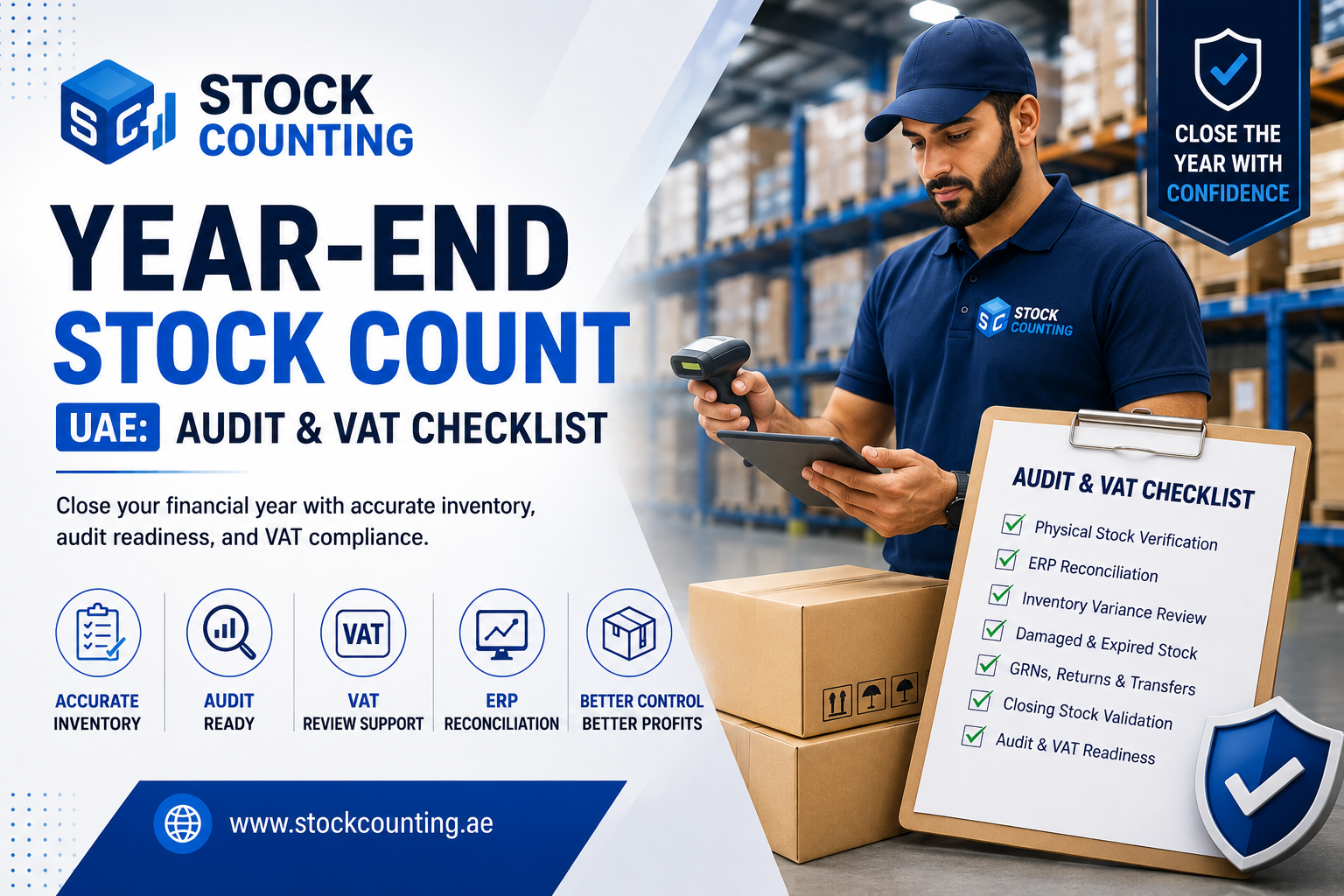
Year-End Stock Count UAE: Audit & VAT Checklist
A year-end stock count that UAE businesses can trust is more than a warehouse exercise. It supports closing stock value, audit preparation, VAT review, ERP reconciliation, purchasing decisions, and management reporting.
For retailers, restaurants, supermarkets, warehouses, manufacturers, pharmacies, trading companies, and e-commerce sellers, the key question is simple: does your system stock match the physical stock you actually have?
The Federal Tax Authority provides VAT guides, references, and clarifications to help businesses understand VAT obligations. UAE businesses are also preparing for eInvoicing, where the Ministry of Finance defines an eInvoice as structured invoice data exchanged electronically and reported to the FTA. The MoF also clarifies that PDFs, Word files, images, scanned copies, and emails are not eInvoices.
A stock count is not tax advice. It supports accounting, VAT review, audit files, ERP accuracy, and operational control. For VAT or audit treatment, speak to your accountant, tax advisor, or auditor.
Why a Year-End Stock Count Matters
A year-end stock count confirms the physical inventory available at or near financial year-end. It helps business owners, CFOs, accountants, and auditors compare actual stock with ERP, POS, warehouse, or accounting records.
A proper year-end count should cover saleable stock, damaged stock, expired stock, slow-moving stock, dead stock, branch stock, warehouse stock, returns, supplier claims, and high-value inventory.
The final output should help management understand what was counted, what the system showed, where the variance came from, and what needs to be corrected before closing the books.
Why Closing Stock Accuracy Matters for Audit and VAT Review
Closing stock affects cost of goods sold, gross profit, stock valuation, purchasing, and financial reporting. If stock is overstated, profit may look stronger than reality. If stock is understated, margins may look weaker and purchasing teams may order unnecessary stock.
For VAT review, stock differences do not automatically create a VAT error. The risk appears when invoices, credit notes, returns, stock write-offs, tax codes, and ERP records do not support each other.
For eInvoicing readiness, businesses should also keep item names, quantities, units of measure, prices, and tax codes clean. As invoicing becomes more system-driven, poor item and inventory data can create avoidable problems.
What to Check Before Year-End Stock Count
Before starting the count, clean the item master data. Remove duplicate SKUs, inactive items, wrong barcodes, incorrect units of measure, and unclear product names.
Next, review physical stock locations. Make sure warehouse racks, shelves, bins, branches, and back-store areas are clearly labelled. Stock that is physically available but stored in the wrong location can look like missing stock.
Then check damaged, expired, and returned items. These should not be mixed with normal saleable stock. Restaurants, supermarkets, pharmacies, and FMCG businesses should pay special attention to expiry dates, wastage, and packaging damage.
Also review goods received notes, supplier invoices, delivery notes, sales invoices, dispatch records, branch transfers, and stock adjustments. Most year-end variance issues come from daily transactions that were not recorded properly.
Finally, stop unnecessary stock movement during the count window where practical. If stock continues moving during the count without proper control, the final report becomes harder to reconcile.
Common Year-End Inventory Problems in UAE Businesses
Many UAE businesses discover similar issues during year-end:
- ERP stock does not match physical stock.
- Negative inventory appears in the system.
- Items are stored in the wrong branch, bin, rack, or warehouse.
- Damaged or expired stock is still shown as saleable.
- Customer returns are mixed with normal stock.
- Supplier shortages were not recorded.
- Transfers between branches are pending or duplicated.
- POS and ERP systems are not syncing correctly.
- Manual stock adjustments were posted without approval.
These are not only warehouse problems. They affect finance, purchasing, sales, audit preparation, VAT review, and management decisions.
Industry-Specific Stock Count Tips
Retailers and supermarkets should focus on fast-moving SKUs, shrinkage, shelf stock, back-store stock, barcode accuracy, and expiry-based products.
Restaurants and cafés should count key ingredients, packaging, wastage, frozen items, high-cost products, and expiry-sensitive inventory before year-end food cost review.
Warehouses should count by bin, pallet, batch, location, and dispatch area. This helps identify stock that is not missing but simply stored in the wrong place.
Manufacturers should separate raw materials, work-in-progress, finished goods, rejected items, scrap, and goods under quality inspection.
Pharmacies and healthcare suppliers should reconcile batches, expiry dates, high-value products, returned items, and supplier claims.
E-commerce businesses should compare ERP stock with marketplace stock, warehouse stock, cancelled orders, pending returns, and courier dispatch records.
When Should You Book a Professional Stock Count?
Book early if your auditor needs year-end stock evidence, ERP stock has repeated variances, stock value is material, you operate multiple warehouses or branches, or your internal team cannot count independently.
You should also consider professional help before ERP migration, VAT/accounting review, branch opening or closure, warehouse relocation, or major stock cleanup.
Waiting until the final week increases pressure, overtime, and mistakes. A planned stock count gives the finance team more time to review variance, approve adjustments, and prepare closing reports.
How StockCounting.ae Can Help
StockCounting.ae supports UAE businesses with professional stock counting, stock verification, stock reconciliation, warehouse stock audits, restaurant and retail inventory counts, fixed asset verification, and audit-supporting stock reports.
A professional stock counting team can help with physical stock verification, ERP vs physical stock reconciliation, SKU-level counts, bin and location-level counts, inventory variance reporting, year-end stock count reports, and monthly or quarterly stock audits.