
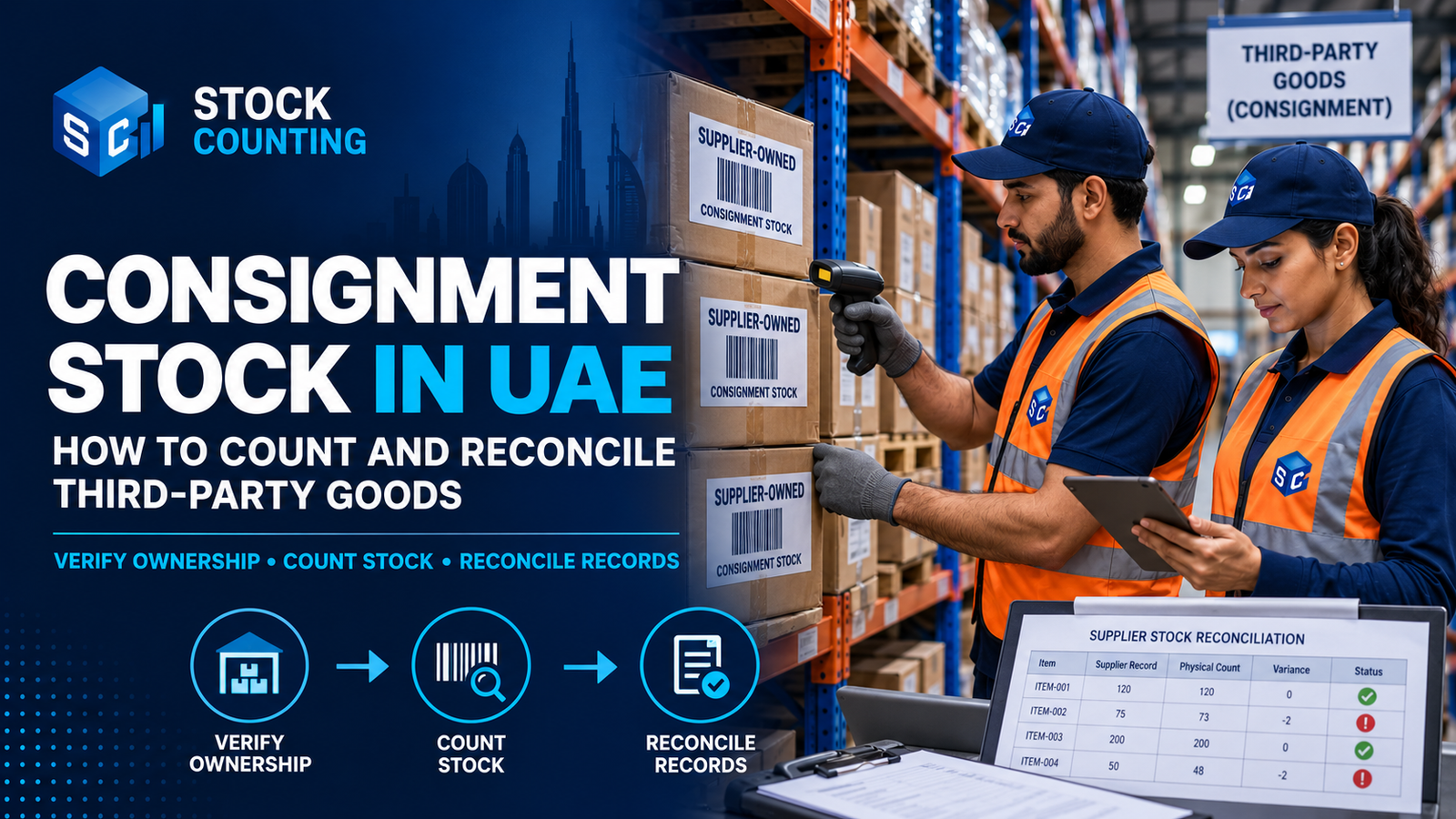
Consignment Stock in UAE: How to Count and Reconcile Third-Party Goods
A stock count can match the warehouse records and still leave an important question unanswered: who owns the goods?
For UAE suppliers, retailers and distributors, consignment stock reconciliation needs to establish both quantity and ownership. It should explain which goods remain supplier-owned, which have sold or been consumed, and which movements are still disputed.
To reconcile consignment stock, separate balances by owner, count the goods, compare both parties’ records at the same cut-off, investigate differences and obtain confirmation of the closing position.
What Is Consignment Stock?
Consignment stock is inventory held by one business while ownership remains with another until an agreed event, commonly resale or consumption. The supplier is the consignor; the business holding the goods is the consignee.
Check the agreement rather than relying on the word “consignment” in a product description. Ordinary credit purchases and third-party warehousing are not automatically consignment arrangements.
Before counting, confirm the ownership-transfer event, reporting frequency, return conditions and responsibility for shortages or damage. Agree who can approve corrections and who will provide records for reconciliation.
Warehouse staff should verify quantities, sales or operations should validate reported sales and consumption, and finance should review adjustments. Nominate one coordinator to obtain supplier responses and keep the review moving.
Prepare a Register That Identifies Each Owner
Create a separate balance for each owner, item and location. Identical products may include both company-owned and supplier-owned units; a product barcode alone should not be treated as proof of ownership.
Use an owner field in your inventory system or maintain a controlled supporting register. Microsoft’s consignment workflow similarly distinguishes the inventory owner from the receiving business.
| Record | Information to include |
| Ownership | Supplier’s legal name, owner code and agreement reference |
| Product | Internal and supplier item codes, description and unit of measure |
| Traceability | Batch, serial number and expiry date, where relevant |
| Location | Warehouse, branch, storage bin and person responsible |
| Status | Available, damaged, awaiting return or ownership unresolved |
Include owner identification in your stock-system implementation and receiving procedures. Where ownership is unclear, flag the goods for investigation rather than allocating them to make a supplier balance match.
Keep disputed ownership separate from an agreed quantity: the team may confirm that goods exist while still needing documents to identify the rightful owner.
How to Count Consignment Inventory
Prepare count sheets by owner and location, covering displays, receiving areas, returns storage and damaged-stock areas.
Agree a count cut-off and pause movements of the selected goods. Arrange independent recounts of discrepancies before accepting expected system quantities.
Check in both directions: locate items appearing in the register, then check that goods found physically appear in the register. Retain zero-count lines and record unlisted items separately. Record the count date, time, counter and recount result, retaining the original entry when a correction is necessary.
Keep physical quantity distinct from availability. Damaged or reserved goods may still be present and require identification, even though they cannot be offered for sale.
For independent stock verification in the UAE, define the required ownership breakdown before the count begins. A report containing only product totals will not answer owner-specific questions.
How to Reconcile Consignment Stock
Align the records and reporting period
Start with the last agreed balance for each supplier. Trace receipts, ownership transfers, sales or consumption, returns, relocations and authorised corrections to the count date.
Match supplier references to internal product codes and confirm units of measure. Check transaction dates against posting dates so late entries are assigned to the correct period.
Where reports use different cut-offs, document intervening movements to bring them to a common point. Retain original exports and record any changes made to standardise the working data.
Separate ownership transfers from physical movements
Goods can change ownership without leaving the warehouse. Conversely, moving supplier-owned goods between locations does not necessarily change their owner. Keep these events separately identifiable.
Where a sale or consumption event also triggers an ownership transfer, link the transactions and ensure the consignment quantity is reduced only once. Do not deduct an ownership change and the associated physical issue as two unrelated reductions.
Check that stock transferred into company ownership appears in the appropriate company-owned balance, with subsequent movements recorded there.
Investigate differences before adjusting balances
Review receiving documents, issue records, sales reports and return acknowledgements. Distinguish a physical shortage from a timing difference, incorrect owner code or product-mapping error.
Do not offset unrelated shortages and surpluses across suppliers or products. Where evidence confirms a misallocation, make linked, authorised corrections rather than concealing the original discrepancy.
Record the reason, evidence, approver and transaction reference for every adjustment. Inventory movements and corrections should remain traceable through supporting documents.
Keep Returns, Damage and Transit Stock Visible
Separate a return request, return approval, physical dispatch and confirmed supplier receipt. Do not mark goods as returned merely because collection has been arranged.
Maintain a return-in-transit schedule for dispatched goods awaiting acknowledgement. Keep these quantities separate from stock physically at your premises, while checking the agreement before changing ownership records.
For customer returns, verify the original transaction, condition and ownership position before restoring consignment availability.
Notify the supplier of damaged goods and retain inspection evidence. Obtain any required authorisation before disposal. Responsibility for losses and damage should follow the agreement, not an assumption that the business holding the goods must always bear the cost.
Confirm the Balance and Close Outstanding Matters
Send each supplier an itemised reconciliation showing quantities by location, condition, movements and unresolved differences. Request confirmation from someone authorised to review the balance.
Ask whether the supplier agrees to quantities only or also to condition and reported movements. Do not interpret silence as acceptance.
If you are the consignor, maintain a corresponding schedule for every consignee. Follow up missing confirmations and arrange further verification where discrepancies remain unexplained.
Keep the quantity reconciliation separate from financial settlement. Review prices, commissions, credit notes and payment deductions against the agreed commercial terms after explaining stock movements.
For businesses applying IFRS 15, revenue recognition depends on transfer of control, not simply the location of goods. A signed stock statement is supporting evidence, not a substitute for that assessment.
Seek qualified UAE accounting, tax or legal advice where the agreement raises VAT, customs or ownership questions.
Close with approved adjustments, supplier responses and an exception register naming the person responsible and deadline for each unresolved item. Obtain warehouse and finance sign-off on their respective checks. Retain signed count sheets and supplier correspondence together for future reference.
Prevent the Same Consignment Differences Recurring
Set a reconciliation schedule based on movement levels, value and supplier requirements. Use targeted cycle counting between full reviews, focusing on repeatedly disputed items.
Monitor overdue confirmations, aged returns and ownership changes without supporting references. Assign responsibility for resolving each exception rather than carrying unexplained balances forward.
A useful automated check is to flag reductions in supplier-owned inventory without a matching authorised transaction. Review alerts before posting corrections; automation should support investigation, not replace approval.
Where records remain inconsistent, stock reconciliation services in the UAE can support variance analysis and corrective recommendations. A completed consignment reconciliation should leave three clear answers: what is physically held, who owns it and what explains the movement since the previous agreed balance.