
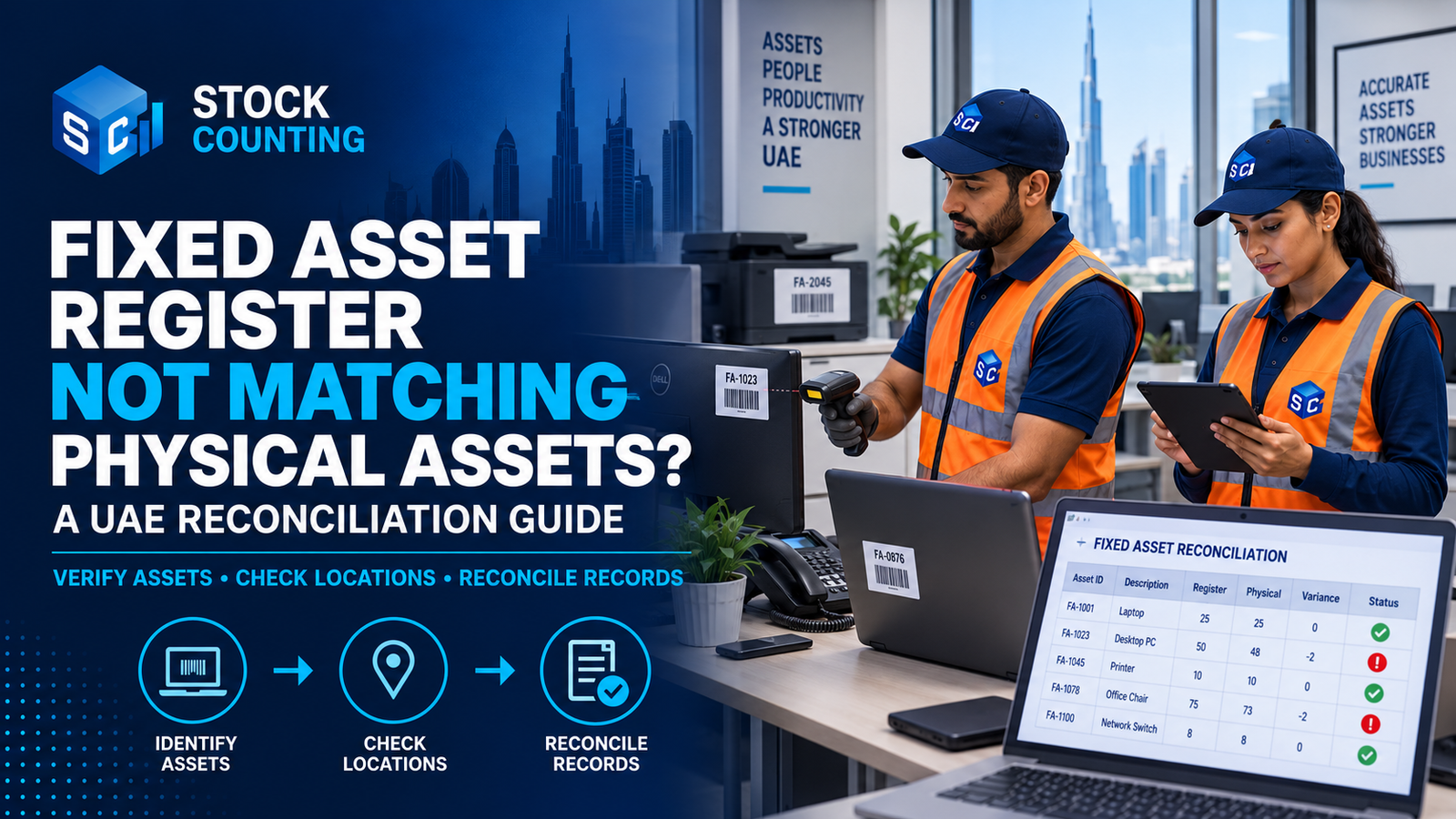
A fixed asset register can appear complete and still contain significant inaccuracies. Equipment may have moved between departments, old assets may remain on the register after disposal, new purchases may never have been added, or physical assets may exist without a clear accounting record.
For UAE businesses, these differences can affect asset control, financial reporting, audit readiness and management’s ability to know what equipment the business actually holds.
Fixed asset reconciliation is the process of comparing physical assets with the fixed asset register, investigating differences and aligning validated asset records with the relevant accounting balances.
The objective is not simply to make two totals agree. A reliable reconciliation should explain what the asset is, where it is located, who is responsible for it and how it is reflected in the accounting records.
Why Does a Fixed Asset Register Stop Matching Physical Assets?
Fixed asset register discrepancies often develop gradually rather than from one major event.
Common causes include:
- Assets transferred between offices without updating the register
- Equipment assigned to employees without recording the custodian
- Disposals that were physically completed but not removed from the records
- New equipment purchased but not added to the fixed asset register
- Incorrect or missing asset tags
- Duplicate asset records
- Equipment sent for repair or temporarily held off-site
- Changes in asset descriptions or serial numbers
- Incorrect accounting classifications
- Incomplete information received from procurement or operations
A missing asset should not automatically be treated as a loss. It may simply have been transferred, renamed, replaced or recorded under another reference.
The first objective is therefore to classify the discrepancy before correcting it.
Prepare the Fixed Asset Register Before Physical Verification
Do not begin physical verification with an uncontrolled spreadsheet containing incomplete information.
Prepare a dated copy of the fixed asset register and identify the legal entities, branches, departments and locations included in the exercise.
A useful fixed asset register should contain enough information to identify each asset.
| Information | What should be available |
|---|---|
| Asset identification | Asset ID, description and asset tag |
| Supporting identification | Serial number, model or other unique reference |
| Location | Office, branch, room, site or department |
| Custodian | Employee or department responsible |
| Acquisition details | Purchase date, supplier and invoice reference |
| Accounting details | Cost, asset class, useful life and accumulated depreciation |
| Verification details | Physical status, verification date and comments |
Where the existing information is incomplete, fixed asset register preparation should be completed or improved before significant corrections are made.
Also establish a clear verification cut-off date. Purchases, transfers and disposals occurring after that date should be recorded separately so that the physical exercise and accounting records remain comparable.
Perform Physical Asset Verification in Both Directions
A professional fixed asset verification in UAE should not simply involve walking through the register and ticking assets that can be found.
Two separate checks are important.
Register-to-Physical Verification
Start with the fixed asset register and locate each recorded asset physically.
Confirm, where applicable:
- Asset tag
- Description
- Serial number
- Location
- Custodian
- Physical condition
This helps identify assets that are recorded but cannot be located.
Physical-to-Register Verification
Then inspect the premises independently and trace the assets you find back to the register.
This helps identify equipment that physically exists but may not appear in the asset records.
This second step is important because finding every asset listed on a register does not prove that the register is complete.
For larger or multi-location businesses, structured fixed asset verification services can help create a consistent verification methodology across locations.
Investigate Fixed Asset Register Discrepancies
Once verification is completed, classify the exceptions rather than immediately adjusting the records.
Asset Recorded but Not Physically Located
Check:
- Previous location
- Employee assignment
- Internal transfer records
- Repair or maintenance documents
- Disposal approvals
- IT or administration records
Record the investigation performed and the last known custodian or location.
Do not automatically write off an asset simply because it was not found during the first physical visit.
Physical Asset Found but Missing from the Register
Where equipment exists but no matching record can be identified, review:
- Purchase invoice
- Goods receiving documents
- Expense accounts
- Previous asset registers
- Supplier records
- Related-company ownership
The item may have been expensed, incorrectly classified, recorded under another entity or omitted from the register.
Physical existence alone does not determine the correct accounting treatment. Finance should assess the appropriate treatment using the accounting framework applicable to the business.
Incorrect Location or Custodian
These are generally record-maintenance issues rather than missing assets.
Confirm the current location or responsible employee and update the register using an authorised change record.
Repeated location differences can indicate that the business needs a better transfer and employee-handover process.
Apparent Duplicate Assets
Do not delete a record simply because two descriptions look similar.
Compare:
- Asset numbers
- Serial numbers
- Invoice references
- Acquisition dates
- Asset components
- Locations
Where duplication is genuinely confirmed, document which record should remain and obtain approval before correcting the asset register or accounting records.
Separate Physical Findings from Accounting Adjustments
One of the most important controls in fixed asset register reconciliation is separating operational findings from accounting decisions.
The verification team may report:
Asset exists but is damaged.
That does not automatically determine whether the asset should be written off.
Similarly:
Asset is fully depreciated.
That does not mean it should disappear from the register if it remains physically in use.
Finance should separately evaluate whether a finding affects depreciation, impairment, disposal or another accounting treatment.
This distinction prevents warehouse, administration or verification teams from unintentionally making accounting decisions simply by changing an asset status.
For material adjustments, historical errors or tax implications, obtain appropriate accounting or UAE tax advice before posting corrections.
Reconcile the Fixed Asset Register with the General Ledger
After physical discrepancies have been investigated, compare the corrected fixed asset register with the relevant general-ledger balances.
Do not compare only the final net book value.
Reconcile separately:
- Gross asset cost
- Additions
- Disposals
- Transfers where relevant
- Accumulated depreciation
- Impairment adjustments
- Net carrying amount
Investigate differences such as direct journals posted to fixed asset accounts, additions that were never created in the asset register or disposals recorded in only one system.
Avoid posting an unexplained balancing journal simply to force the register and ledger to agree.
A proper fixed asset reconciliation should leave a clear audit trail showing how each material difference was resolved.
Use Asset Tagging to Improve Future Accuracy
Assets that cannot be uniquely identified are much harder to reconcile.
A structured fixed asset tagging and labelling process can connect each physical item to a unique record.
Depending on the business and asset type, tags may contain:
- Unique asset number
- Barcode
- QR code
- Department or location information
- Other internal references
However, tagging does not replace a reliable register. The tag and the underlying record must remain connected throughout the asset’s life.
If a damaged tag is replaced, the replacement should remain linked to the original asset record rather than creating a new asset unnecessarily.
What Should Happen After Fixed Asset Reconciliation?
Once the differences have been resolved, prepare a final exception and action report.
Each outstanding item should identify.
| Item | Required action |
|---|---|
| Missing asset | Continue investigation or escalate |
| Wrong location | Update approved location |
| Incorrect custodian | Update responsibility |
| Unrecorded asset | Investigate supporting records and accounting treatment |
| Duplicate record | Validate and correct |
| Damaged asset | Refer for operational and accounting review |
| Disposal not recorded | Obtain evidence and process authorised correction |
Assign every unresolved item to a responsible person with a deadline.
Finance should approve accounting changes, while operational teams should confirm location, custody and physical status.
How Can UAE Businesses Prevent Future Asset Register Differences?
The strongest asset reconciliation process is one that reduces the need for major corrections later.
Businesses should build asset updates into normal operations.
Record new assets when purchases are processed. Document movements between offices and departments. Update employee assignments when equipment changes hands. Obtain approval before disposals and update the register promptly.
For mobile and higher-value assets, perform periodic physical verification instead of waiting several years for a complete reconciliation exercise.
Technology can also help. Automated controls can flag:
- Duplicate serial numbers
- Employees leaving with assets still assigned
- Assets with no recorded location
- Purchases without corresponding asset records
- Long-outstanding verification exceptions
AI-assisted matching can also help identify possible matches between purchase records, asset descriptions and physical verification results. However, proposed matches and accounting adjustments should still be reviewed and approved by responsible personnel.
A Reliable Fixed Asset Register Should Explain More Than the Total
Successful fixed asset reconciliation in the UAE should answer four basic questions:
What assets does the business have? Where are they located? Who is responsible for them? How are they reflected in the accounting records?
When those questions cannot be answered, simply matching the register total to the general ledger is not enough.
A properly reconciled fixed asset register provides management with clearer asset visibility, supports financial reporting and creates accountability for unresolved differences.
The objective is therefore not just to produce a cleaner spreadsheet. It is to maintain identifiable physical assets, reliable records, supported accounting balances and a clear process for resolving exceptions.